


HIGHLIGHT
Showcasing the Finished Mobile Designs for FreeMind

PROBLEM
Why do many task and focus apps not work well for neurodivergent users?
Many neurodivergent users struggle not with planning but with starting and staying engaged in tasks, often experiencing avoidance, executive dysfunction, and resistance to strict routines

MY GOAL
To design an app that helps neurodivergent users manage tasks and focus in a way that fits their needs.

USER RESEARCH
For my Data Collection I read and reviewed 50 posts from an online reddit groups called “r/productivity” & “r/ADHD”.
Thematic Analysis
The thematic analysis focused on this question: Why do traditional task and focus apps fail neurodivergent users, and how can a better system support task initiation, engagement, and flexible routines? The top 50 most-voted posts responding to this or similar questions were selected.
Code System and Themes
These were the key themes identified when conducting the thematic analysis . Other than the coping strategies and workarounds the rest of the themes are pain points .
External Accountability & Support
Social Commitment & Accountability
Body Doubling & External Motivation
Struggles with Task Management Apps
Lack of Visualization
“Out of sight , out of mind “
Need for simplicity & Customization
Notification fatigue & prioritization issues
Notification fatigue & prioritization issues
Inability to maintain consistency
Coping Strategies & Workarounds
Reward System
Task Breakdown
Resilience
Avoiding rigidity & embracing novelty
Timers, reminders, and visual cues
Time Perception & management
Over/Underestimating Task effort
Challenges in habit formation
Time Blindness
Time Perception & management
Burnout & Abandonment
Inconsistent prioritization
Analysis paralysis & indecision
Difficulty transitioning between task
Task avoidance & Procrastination
Frequency of Themes & Code Relations Browser
The Amount of times each theme was mentioned in the thematic analysis

Frequency of Themes

Code Relations Browser Proximity (1)
Affinity Diagram
In this stage, I used an affinity diagram to organize insights from the thematic analysis. MAXQDA’s heat map helped visualize connections between themes, showing how challenges like task initiation, accountability, and motivation are linked.

User Flow Chart
Beginning user flow chart for the app, by the time of the final app design things were changed especially after user interviews and testing.

User Personas
Using insights from the thematic analysis and affinity diagram, I created two user personas that reflect key pain points and needs of neurodivergent users.
Jordan Lee

Age
23
Education
Bachelors in CS
Occupation
Software Developer
Location
San Francisco, CA
My brain moves a mile a minute—I need a system that can keep up without slowing me down
Personality
Energetic
Impulsive
Hyperfocused
Bio
Jordan is a high-energy, idea-driven person who thrives on excitement and novelty. They love tackling new projects but struggle with follow-through, prioritization, and impulsivity. Their brain jumps from one idea to the next, and they often start more tasks than they finish. They work as a software developer but constantly procrastinate on boring or repetitive tasks in favor of exciting new challenges. While they excel in creative problem-solving and brainstorming, they lose track of deadlines and forget to check their task lists.
Core needs
•
Needs short, structured work bursts with rewards.
•
Small dopamine boosts for completing tasks.
•
Works better when checking in with others.
Frustrations
•
Starts too many things at once and doesn’t finish them.
•
Task lists feel boring and overwhelming, so he avoids them.
•
Either ignores tasks completely or overcommits.
•
Needs something fluid and dynamic.
Apps

Sarah Warren

Age
30
Education
Masters in Business
Status
Married
Occupation
Marketing Sales
Location
Seattle, Washington
I need a system that works with my brain, not against it
Personality
Introvert
Thinker
Spender
Bio
Sarah is a 30-year-old marketing professional who was diagnosed with ADHD in her mid-20s. She is highly creative and passionate about her work but struggles with task initiation, time management, and staying on track with routines. Despite trying multiple productivity tools, she often abandons them due to overwhelm, rigid structures, or lack of engagement. She wants a system that adapts to her needs, keeps her motivated, and doesn’t make her feel like a failure when she struggles.
Core needs
•
Too many features create distractions rather than helping.
•
She needs to tweak and adapt her system continuously.
•
If something isn’t front and center, she forgets it exists.
Frustrations
•
She has to recommit to productivity systems constantly because they never become second nature.
•
Forgets to check her calendar, dismisses reminders, and gets distracted.
•
She has tried countless task management apps, but none seem to work long-term.
•
Even when she follows a plan, she doesn’t feel a sense of accomplishment.
Apps

Design Requirements
Based on the affinity diagram and key insights, I developed five design requirements that directly address the core challenges

Task Initiation & Engagement
Help users overcome barriers to starting and staying engaged with tasks.

Flexible Routines
Support routines that adjust to varying energy and focus levels.
Minimize Cognitive Load
Keep the interface simple with limited options to reduce cognitive load.

Visual Reminders & Reinforcement
Use reminders and cues to keep tasks visible and reinforce completed activities.

Focus Timers & Growth System
The app should provide strategies to help users overcome barriers to starting tasks and maintain engagement throughout.

I analyzed 10 neurodivergent-friendly productivity apps to understand how they support task management and engagement. I analyzed all of their features and looked at out of class examples as well.
Competitor & Best-in-Class Research
To design a better productivity app, I studied top apps and competitors. I looked at screenshots to find useful features, layouts, and user flows. This helped me create a more intuitive and neurodivergent-friendly design.

Screenshots of Features from the 10 competitors

Flora

Focus Keeper
MARKET RESEARCH
Design Process & Ideation
Shaping the Wireframe from Research Insights
Feature Analysis
I conducted a comprehensive competitive analysis, organizing screenshots by essential features observed across both competitors and industry leaders. For each feature, I critically evaluated multiple design variations, identifying their strengths and weaknesses to pinpoint standout layouts and extract key microfeatures. This systematic approach directly informed the creation of an optimized design
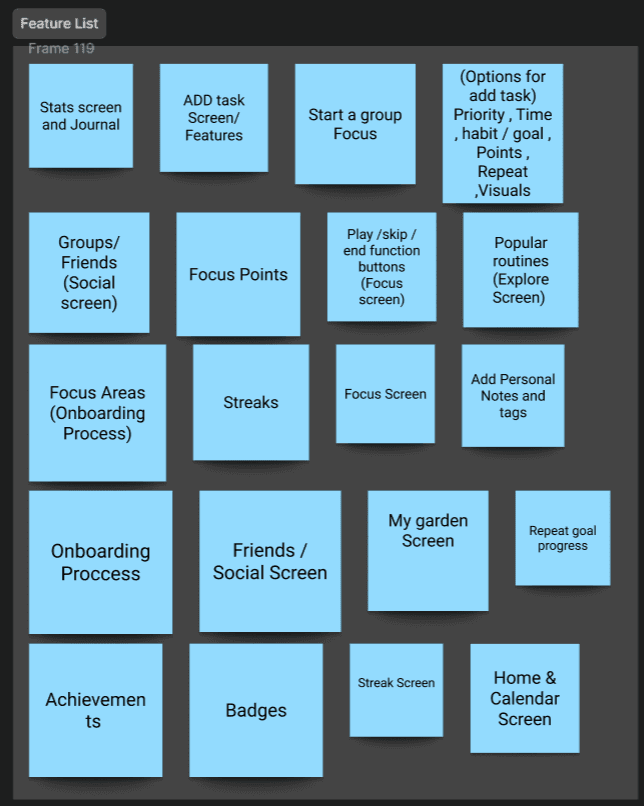
Feature List for FreeMind
Wireframing
Based on the most effective layouts and elements, I integrated key microfeatures to create an optimized design that met the design requirements.
Combining the sections
Once each section is wireframed , I combine all sections/Features into one page. For the Home page it was the Header , task list , and bottom navigation. This process was used for the rest of the screens .
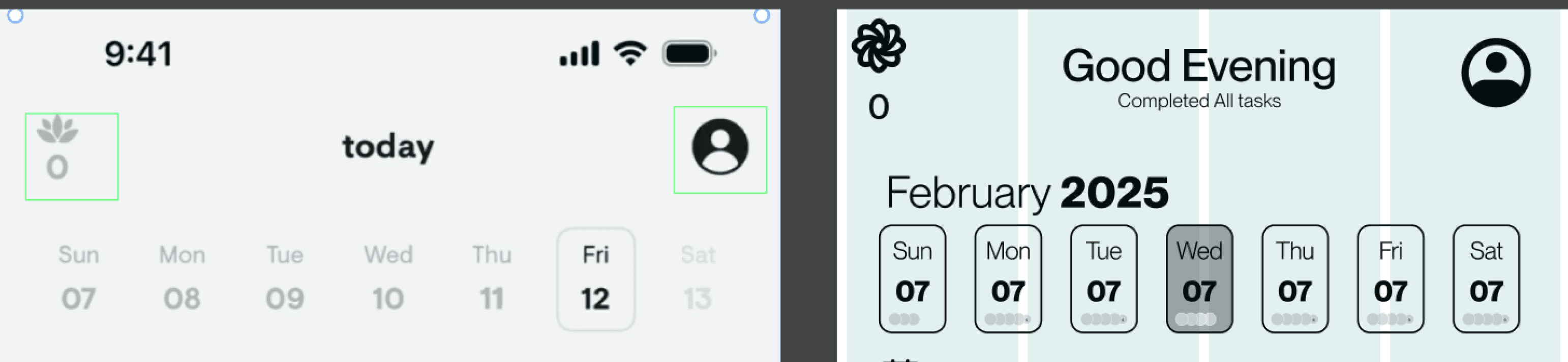
Early Home Screen Header Wireframe

Early Task List Wireframing

Home Screen Header

Task List

Bottom Navigation

Screenshots of each Feature

Home Screen Headers


Add task options , Explore, focus , and Friends Screen
User Feedback & Testing
To better understand how people interact with the app, I conducted user testing with a small group of general users through the use of Maze. Their feedback helped identify what worked well and where the experience could be improved, especially around navigation, clarity, and visual design.
Navigation needs more polishing as some icons weren't highlighted when selected .
Some UI elements lacked clarity or needed visual hints to explain their function.
Text size and spacing varied; some elements were too small or hard to read.
Certain elements on the task screen were visually hard to distinguish.
Users wished they could add other activities in the app like meetings and events
The onboarding process felt simple and easy to follow.
The Explore page was helpful for users who weren’t sure what to do next.
The Streak screen was motivating and encouraged consistency.
WIREFRAME
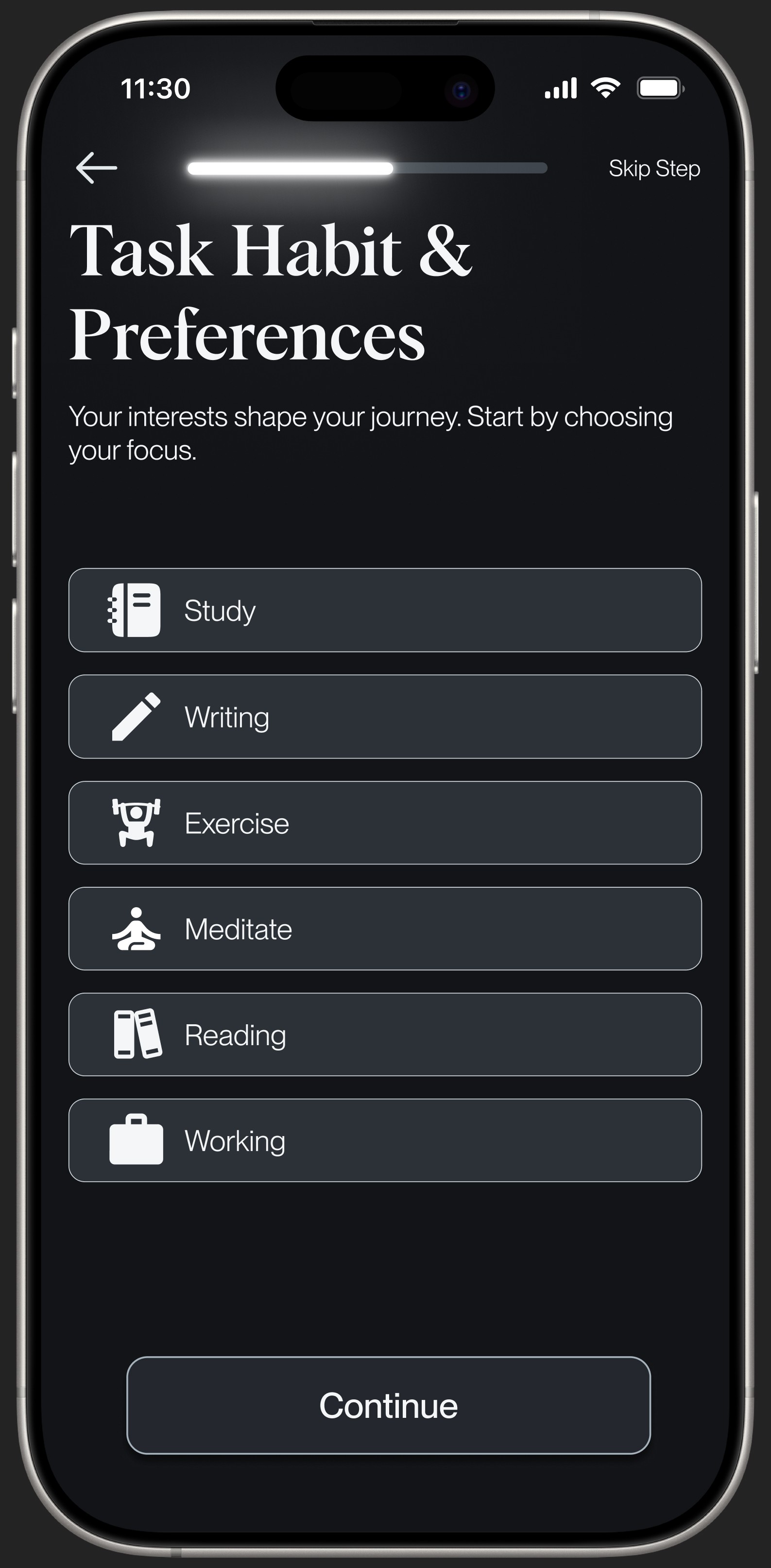
After incorporating the best features, I moved into wireframing to explore layout and structure.


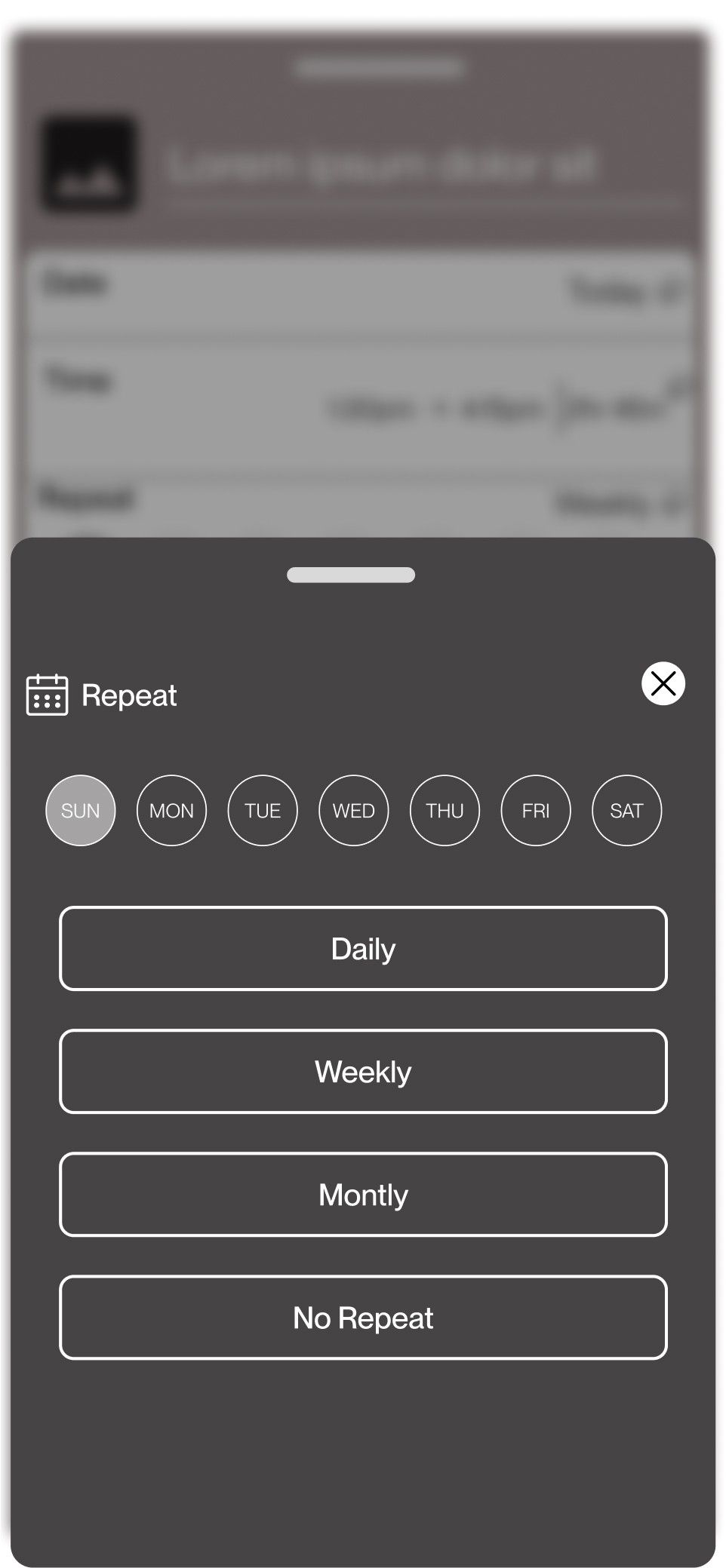
Onboarding Process & Home Screens




FINAL DESIGNS
Highlighted final screens after incorporating feedback

Reflections & Takeaways
A Journey of Focus, Friction, and Growth
Key Takeaways
Visual Identity Challenges

Research vs. Execution

Consistency in Design

Designing for Neurodivergence

Color Palette
50
#f4f6f7
100
#e3e8ea
200
#cad2d7
300
#a5b2bb
400
#788a98
500
#5d6e7d
600
#505d6a
700
#454f59
800
#3e454c
900
#373c42
950
#121417
Typography
Aa
Aa
Albra - Bold
Albra - Medium
Albra - Regular
Base Value: 32
Scale: 1.25
50px
1.562rem
40px
1.250rem
32px
1.000rem
26px
0.812rem
20px
0.625rem
PP Neue Montreal - Medium
PP Neue Montreal - Book
Base Value: 16
Scale: 1.25
20px
1.250rem
16px
1.000rem
13px
0.812rem
Style Guide
16
16
78
852

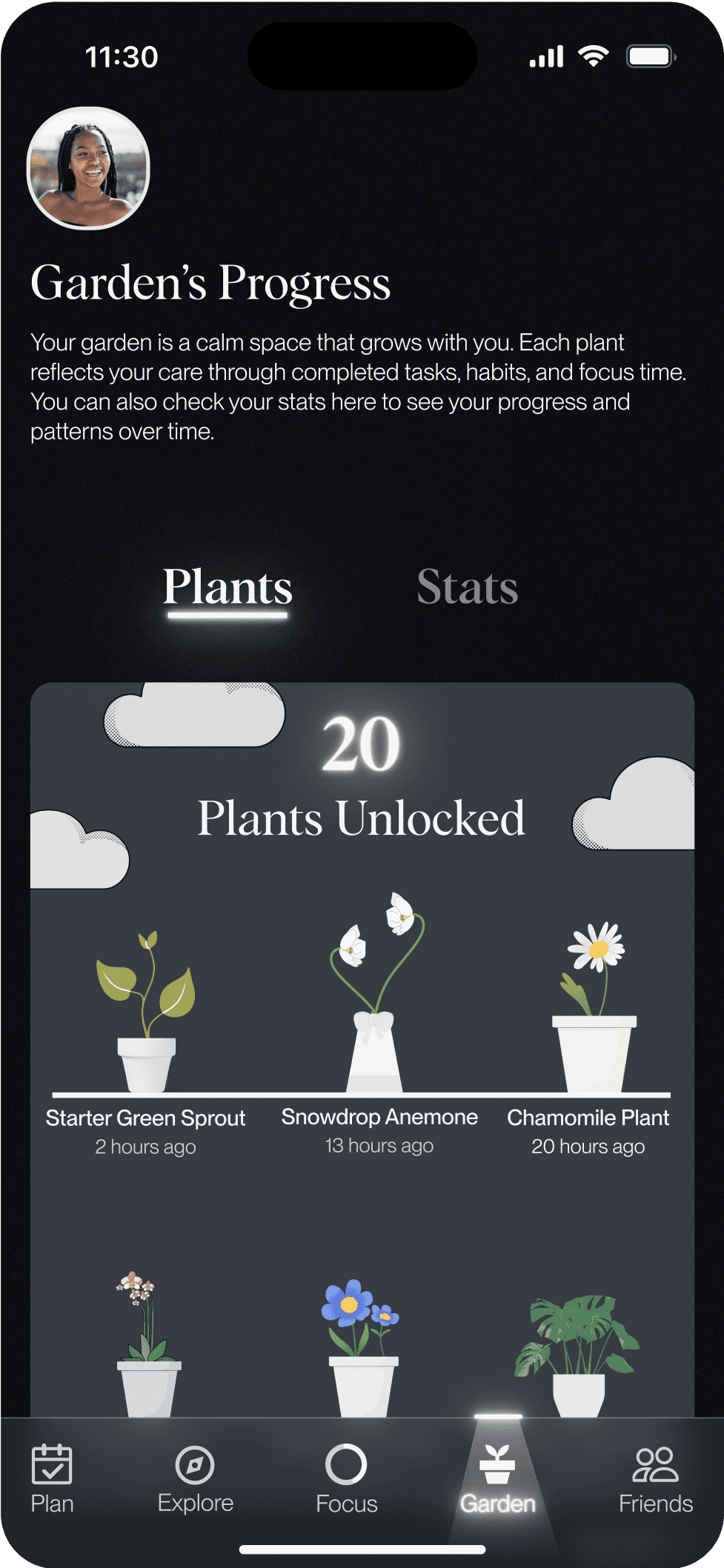




Welcome to FreeMind.
A flexible, neurodivergent-friendly way to manage tasks, build habits, and stay focused without the stress.
Start


Day 4

Grow Your Streak
Each day you stay on track, you’ll earn a new petal for your sunflower. Complete 16 days in a row to receive 50 points and unlock a new sunflower for your garden! Keep growing, one petal at a time.
This Week
Sun
Mon
Tue
Wed
Thu
Fri
Sat
Your Longest Streak
8 Days


Continue
My Role
UX/UI Designer and Researcher
Tools - Figma, Framer , MAXQDA , After Effects, and Maze
Timeline
February - April 2025
Overview
Freemind is a task management app designed for neurodivergent users, featuring a streak and focus system that encourages consistency and engagement through flexible routines and rewarding progress
The project was featured at Convergence 2025, UF's Digital Worlds Institute annual showcase.
Prototype Link - FreeMind
FreeMind
Neurodivergent Task app ─ June 2025
CONTENTS